Guide
6 Best Trailer Brake Controllers
Best trailer brake controllers verified on Amazon: proportional and time-delayed picks from Tekonsha, REDARC, CURT and Reese for 1-4 axle trailers.
The short answer: buy proportional unless the budget truly forbids it. The Tekonsha Prodigy P3 is the benchmark — four axles, color diagnostics, five stored profiles (top pick). The REDARC Tow-Pro Elite hides under the dash and adds an off-road mode, the CURT Echo Mobile skips wiring entirely over Bluetooth, and the CURT Spectrum pairs a factory-look dash knob with four-axle capacity. The Tekonsha Primus IQ is the value proportional pick, and the Reese Towpower Brakeman IV is the time-delayed budget floor. Every pick was triple-matched by brand, part number and fitment against a checked Amazon listing with a verified image on 2026-11-25 — see how we test and verify. We print no prices; the listing shows today’s. Brake control is half the towing setup — the visibility half is the tow mirrors guide.
Quick Comparison Table
Detailed Product Reviews
 Check Price on Amazon
Last checked November 25, 2026
Key specs
- Control type: Proportional (internal inertia sensor)
- Capacity: 1-4 axles (2-8 brakes)
- Mounting: Under-dash, bracket or snap-in clip, 360-degree mounting range
- Display: Color LCD with diagnostics, 3 boost levels and 5 stored profiles
- Type: brake controller
- SKU: 90195
Why we recommend it
The Prodigy P3 is the controller other proportional units get measured against, and the reasons are practical rather than flashy. Its internal inertia sensor matches trailer braking to how hard the tow vehicle is actually slowing, including in reverse, so stops feel like one vehicle instead of two. The color LCD reports in plain language instead of fault codes, and five storable profiles mean a driver who rotates between trailers is not re-tuning gain and boost at every hookup. It switches between electric and electric-over-hydraulic brakes, runs continuous diagnostics, and carries a limited lifetime warranty. The trade-offs are size and spend: the full-size box can crowd knee room in smaller cabs.
From the Amazon listing
- Proportional braking with internal inertia sensor
- 1-4 axles (2-8 brakes)
- Color LCD with plain-language diagnostics
Best for: Drivers who tow multiple trailers up to four axles and want the most capable mainstream proportional controller
Pros
- ✓ Smooth proportional braking, including in reverse
- ✓ Stores five trailer and driver profiles
- ✓ Electric and electric-over-hydraulic compatible
Cons
- ✗ Plug-and-play harness sold separately
- ✗ Full-size box can crowd knee room
- ✗ Costs more than the Primus IQ
 Check Price on Amazon
Last checked November 25, 2026
Key specs
- Control type: Proportional plus user-controlled (dual mode)
- Capacity: 1-3 axles
- Mounting: Hidden main unit with dash-mounted remote-head knob
- Display: LED-lit rotary knob (no screen); 12V/24V, active calibration, mounts in any orientation
- Type: brake controller
- SKU: EBRH-ACCV3-NA
Why we recommend it
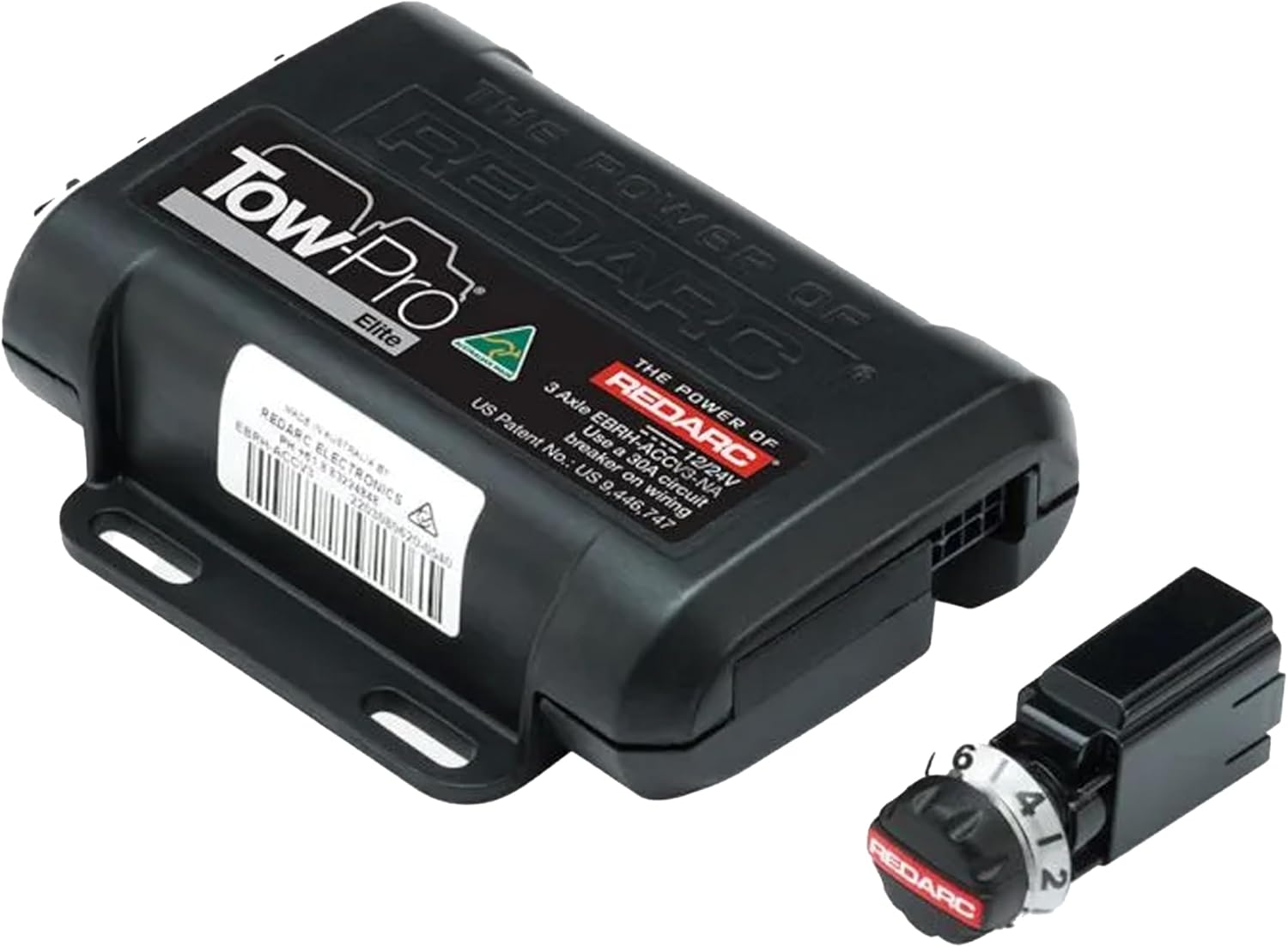
The Tow-Pro Elite hides its main unit under the dash and leaves only a small rotary knob in view, so the cab looks factory instead of accessorized. Its real distinction is the second braking mode: alongside normal proportional control, a user-controlled mode lets the driver hold a set trailer-brake level, the right tool on steep off-road descents where inertia-based control reads the terrain wrong. Active calibration works even with no trailer attached, the unit mounts in any orientation, and it runs on 12V or 24V systems with no manual voltage selection. The costs are literal and functional: premium pricing, a professional-install recommendation, settings read from knob position and LED color rather than a numeric display, and a three-axle ceiling.
From the Amazon listing
- Proportional plus user-controlled dual braking modes
- 1-3 axles
- Hidden main unit with dash remote-head knob
Best for: Overland and off-road towers who want a factory-look dash and a dedicated off-road braking mode
Pros
- ✓ User-controlled mode for steep descents
- ✓ Factory-look dash knob install
- ✓ Works on 12V and 24V systems
Cons
- ✗ Premium-priced; pro install recommended
- ✗ No numeric display
- ✗ Three-axle capacity ceiling
 Check Price on Amazon
Last checked November 25, 2026
Key specs
- Control type: Proportional (tri-axis accelerometer)
- Capacity: 1-2 axles (2-4 brakes)
- Mounting: In-line at the rear 7-way connector; zero-tool install, retention strap included
- Display: Smartphone app (Bluetooth) for gain, sensitivity, profiles and manual override
- Type: brake controller
- SKU: 51180
Why we recommend it
The Echo Mobile removes the install from the equation entirely: it plugs in-line between the truck's 7-way socket and the trailer's plug, and a phone app handles gain, sensitivity, profiles and manual override. Braking is genuinely proportional via a tri-axis accelerometer, and if the phone disconnects or takes a call, the controller keeps braking at the last settings. That makes it the natural pick for renters, occasional towers and households that tow with more than one vehicle, since it transfers in minutes. The limits are hard ones: capacity stops at two axles, the manual override lives on the phone screen unless a separate button is bought, and the unit sits exposed at the rear connector, held by its strap.
From the Amazon listing
- Proportional braking via tri-axis accelerometer
- 1-2 axles (2-4 brakes)
- Plugs in-line at the rear 7-way connector
Best for: Occasional towers, renters and multi-vehicle households towing 1-2 axle trailers who refuse to wire a controller into the cab
Pros
- ✓ No wiring, drilling or dash space
- ✓ Moves between tow vehicles in minutes
- ✓ Keeps braking if the phone disconnects
Cons
- ✗ Limited to 1-2 axles
- ✗ Override button is a separate purchase
- ✗ Unit sits exposed at the connector
 Check Price on Amazon
Last checked November 25, 2026
Key specs
- Control type: Proportional (triple-axis accelerometer, auto-leveling)
- Capacity: 1-4 axles (2-8 brakes) per CURT's official product page
- Mounting: Dash-mounted rotary knob plus hidden main module
- Display: 10 tri-color LEDs on the knob; push-button manual override
- Type: brake controller
- SKU: 51170
Why we recommend it
The Spectrum answers the complaint that brake controllers look like afterthoughts: the main module mounts out of sight at any angle, and the only visible part is a rotary knob that reads as factory equipment. Unlike the other dash-knob controllers in this guide, it keeps full four-axle capacity, and its proportional control is auto-leveling with compatibility for low-volt, PWM, ABS, cruise control and electric-over-hydraulic systems. The manual override is a push of the knob itself, which beats reaching for a lever mid-stop. What you give up is information: ten tri-color LEDs replace a numeric gain readout, so exact settings cannot be recorded and repeated, and the two-piece install is more work than a one-box unit.
From the Amazon listing
- Proportional, triple-axis accelerometer, auto-leveling
- 1-4 axles (2-8 brakes) per CURT's official product page
- Dash-mounted rotary knob, hidden main module
Best for: Truck owners who want wired proportional control with a factory-integrated dash look
Pros
- ✓ Factory-look dash knob
- ✓ Full four-axle capacity
- ✓ Override built into the knob
Cons
- ✗ LED-only feedback, no numeric readout
- ✗ Two-piece install takes more work
- ✗ Quick-plug harness sold separately
 Check Price on Amazon
Last checked November 25, 2026
Key specs
- Control type: Proportional (internal inertia sensor, works in reverse)
- Capacity: 1-3 axles (2-6 brakes)
- Mounting: Compact under-dash, bracket or snap-in clip, self-leveling
- Display: LED digital readout with diagnostics and 3 boost levels
- Type: brake controller
- SKU: 90160
Why we recommend it
The Primus IQ is where the money argument for time-delayed controllers falls apart: it delivers genuine Tekonsha proportional braking — the same Prodigy-family inertia sensing, working in reverse, with three boost levels — in a compact body that costs what lesser units charge. It is self-leveling within its mounting range, shows diagnostics on an LED digital readout, and unclips from its snap-in mount for storage between tows. It shares the P3's two-plug harness ecosystem and limited lifetime warranty, which makes upgrading later painless. The compromises are a three-axle ceiling, a basic readout instead of the P3's color screen, and no stored trailer profiles — fine for the one-trailer household it is aimed at.
From the Amazon listing
- Proportional braking with internal inertia sensor
- 1-3 axles (2-6 brakes)
- Compact under-dash, self-leveling, snap-in clip
Best for: Value buyers towing 1-3 axle trailers who want genuine proportional control without paying P3 money
Pros
- ✓ Real proportional braking with boost
- ✓ Compact body unclips for storage
- ✓ Same harness ecosystem as the P3
Cons
- ✗ Three-axle ceiling
- ✗ Basic LED readout, no profiles
- ✗ Harness sold separately
Reese Towpower
Reese Towpower Brakeman IV 8507111 — The Budget Floor
 Check Price on Amazon
Last checked November 25, 2026
Key specs
- Control type: Time-delayed (time-activated, fixed ramp rate)
- Capacity: 1-4 axles (2-8 brakes)
- Mounting: Compact under-dash, any direction
- Display: Digital readout for output (gain) and sync settings, with overload/short protection
- Type: brake controller
- SKU: 8507111
Why we recommend it
The Brakeman IV is the honest floor of this guide: a name-brand, time-delayed controller with a clear digital readout for gain and sync, four-axle capacity, overload and short protection, and a lifetime warranty. Setup is dead simple — gain plus sync, no leveling or calibration, because there is no inertia sensor to level. That missing sensor is also the whole caution: braking ramps to a preset level over a fixed time regardless of how hard you brake, which feels grabby in stop-and-go traffic and weak in a panic stop until the ramp completes. Buy it for light, occasional towing when it is genuinely the cheapest option; if its price sits near the Primus IQ's, the proportional pick is the better spend.
From the Amazon listing
- Time-delayed braking with fixed ramp rate
- 1-4 axles (2-8 brakes)
- Compact under-dash, mounts in any direction
Best for: Budget, occasional towing of lighter trailers where simple and cheap beats smooth
Pros
- ✓ Lowest-cost name-brand pick here
- ✓ Simple gain-plus-sync setup
- ✓ Four-axle capacity, lifetime warranty
Cons
- ✗ Time-delayed braking is less smooth
- ✗ Grabby in stop-and-go traffic
- ✗ No inertia sensing or boost
Buying Guide: How to Choose a Trailer Brake Controller
Proportional vs time-delayed
This is the decision the whole category turns on. A proportional controller measures deceleration and meters trailer braking to match — light pedal, light trailer braking; hard stop, full force. A time-delayed controller simply ramps output to a preset level over a fixed time whenever the brake pedal is pressed, blind to how hard you are actually braking. Five of the six picks here are proportional for a reason. The one time-delayed pick, the Brakeman IV, earns its place on cost and simplicity for light, occasional towing — and its card says plainly where the compromise shows up.
The harness is sold separately — plan for it
Say it once, clearly: every hardwired controller in this guide needs a vehicle-specific plug-and-play harness, and it is not in the box. Trucks with a factory brake-control port take the maker’s two-plug harness and install in minutes; trucks without one use the included universal pigtail and a hardwired install. Order the harness with the controller, not after it arrives. The Echo Mobile is the only exception — it never enters the cab at all.
Wireless and dash-knob alternatives
The Echo Mobile’s convenience comes with two hard limits: the truck’s 7-way socket must have a live brake-output pin (some factory tow packages need a fuse or relay fitted before the Echo gets power), and capacity is capped at 1-2 axles. The dash-knob designs — the Tow-Pro Elite and the Spectrum — hide the module and show only a knob; between them, the Spectrum is the one that keeps full 1-4 axle capacity per CURT’s official figures, while the Elite trades an axle of capacity for its off-road user-controlled mode.
Beware the lookalike controllers
Amazon carries no-name controllers badged “90195” that trade on the P3’s model number. They are not Tekonsha units, and the model number alone proves nothing. The genuine Prodigy P3 is the verified Tekonsha listing on its card here — if the brand on the listing is not Tekonsha, it is a clone riding the number, whatever the title says.
What we left out, and why
- REDARC Tow-Pro Liberty (EBRH-ACCNA) — a strong proportional dash-knob unit, triple-matched by ASIN and part number, but no verifiable Amazon image could be extracted in this pass, so it fails the verified-image gate. It is also limited to 1-2 axles and overlaps the Tow-Pro Elite and Spectrum. First reinstatement candidate if an image is verified.
- Hopkins InSIGHT Plug-In Simple Brake Control (47297) — ASIN and part number verified, and the split display-and-control design is genuinely interesting, but no verifiable Amazon image could be extracted in this pass.
- Tekonsha Prodigy iD (90920) — an OEM-style in-dash proportional controller with smartphone configuration that fits this guide’s theme, but its ASIN and Amazon image were not verified in this pass, so it was not guessed into the slate.
- CURT Echo Under-Dash (51190) — the Bluetooth under-dash Echo variant with 1-4 axle capacity; ASIN and image not verified in this pass. Worth a future check because it answers the Echo Mobile’s two-axle limit.
- Tekonsha Voyager (9030) — an entry-level proportional controller without a display; ASIN and image not verified in this pass, and the Primus IQ covers the value-proportional slot with a display and boost.
🏆 Our Top Recommendation
Tekonsha Prodigy P3 90195 — The Proportional Benchmark
The most capable mainstream proportional controller here: four-axle capacity, a color diagnostic display and five stored trailer profiles in one under-dash unit.
The Prodigy P3 is the controller other proportional units get measured against, and the reasons are practical rather than flashy. Its internal inertia sensor matches trailer braking to how hard the tow vehicle is actually slowing, including in reverse, so stops feel like one vehicle instead of two. The color LCD reports in plain language instead of fault codes, and five storable profiles mean a driver who rotates between trailers is not re-tuning gain and boost at every hookup. It switches between electric and electric-over-hydraulic brakes, runs continuous diagnostics, and carries a limited lifetime warranty. The trade-offs are size and spend: the full-size box can crowd knee room in smaller cabs.
Best for: Drivers who tow multiple trailers up to four axles and want the most capable mainstream proportional controller
Final Thoughts
Most towers should land on the P3 for capability or the Primus IQ for value — both are proportional, both share the same harness ecosystem, and both will out-brake any time-delayed unit. Choose the Echo if wiring is the deal-breaker, the Spectrum or Tow-Pro Elite if the dash has to look factory, and the Brakeman IV only when it is genuinely the cheapest way to tow light and occasionally. Pair the controller with the visibility upgrade from the tow mirrors guide and the towing setup is complete.
Frequently asked questions
Proportional or time-delayed — which brake controller should I buy?
Proportional for almost everyone. A proportional controller (the P3, Primus IQ, Tow-Pro Elite, Spectrum and Echo here) senses how hard the tow vehicle is decelerating and applies the trailer brakes to match, so stops are smooth at any speed. A time-delayed unit like the Brakeman IV ramps to a preset level over a fixed time no matter how you brake — cheaper and simpler, but grabby in traffic and slow to reach full force in a panic stop. Time-delayed makes sense only for light, occasional towing on a tight budget.
Do I need a wiring harness, and is it included?
Every hardwired pick in this guide needs a vehicle-specific plug-and-play harness, and that harness is sold separately — budget for it alongside the controller. Trucks with a factory brake-control port use the maker's two-plug harness for a true plug-in install; without the port, the included universal pigtail covers a hardwired install. The CURT Echo Mobile is the exception: it needs no harness at all, because it plugs in-line at the rear 7-way connector instead.
How many axles can these controllers handle?
Check the card, not the category. The P3, Spectrum and Brakeman IV cover 1-4 axles; the Primus IQ and Tow-Pro Elite cover up to 3 axles; the Echo Mobile is capped at 1-2 axles, which rules it out for triple-axle trailers. Match the controller's ceiling to the largest trailer you actually tow, not the one you might borrow once.
Why does the CURT Echo need a live pin in my 7-way socket?
The Echo draws its power and brake signal from the vehicle's 7-way RV blade socket, so that socket's brake-control output pin has to be live. On some trucks the factory tow package leaves that circuit incomplete until a fuse or relay is fitted under the hood. If the Echo will not power up, completing the tow-package wiring is the first check — the controller itself is rarely the problem.
Related buying guides
Toyota Tundra
2 Best Leveling & Lift Kits for Toyota Tundra
Best Tundra leveling and lift kits by generation: verified picks for the 2007–2021 leaf-spring truck and the 2022+ coil-rear platform, with exclusions.
2 verified picks
Ram 1500
2 Best Leveling Kits for Ram 1500
Ram 1500 (DT) leveling kits split by one question — coil springs or factory air suspension? Two Amazon-sold, manufacturer-verified kits — one for each catalogue.
2 verified picks
Jeep Wrangler
2 Best Lift Kits for Jeep Wrangler JL
Best Jeep Wrangler JL lift kits: two Amazon-sold picks — Mopar's factory 2-inch lift and Rough Country's budget coil kit — plus the verified systems left out.
2 verified picks
Chevrolet / GMC Colorado / Canyon
3 Best Leveling & Lift Kits for Chevrolet Colorado & GMC Canyon
Best Colorado and Canyon leveling and lift kits by generation: verified picks for 2015–2022 and the factory-lift-heavy 2023+ trucks, with ZR2/AT4X exclusions.
3 verified picks
Not fitting it yourself? Budget the install and the alignment with our lift kit cost guide, then find a shop in our verified installer directory.